


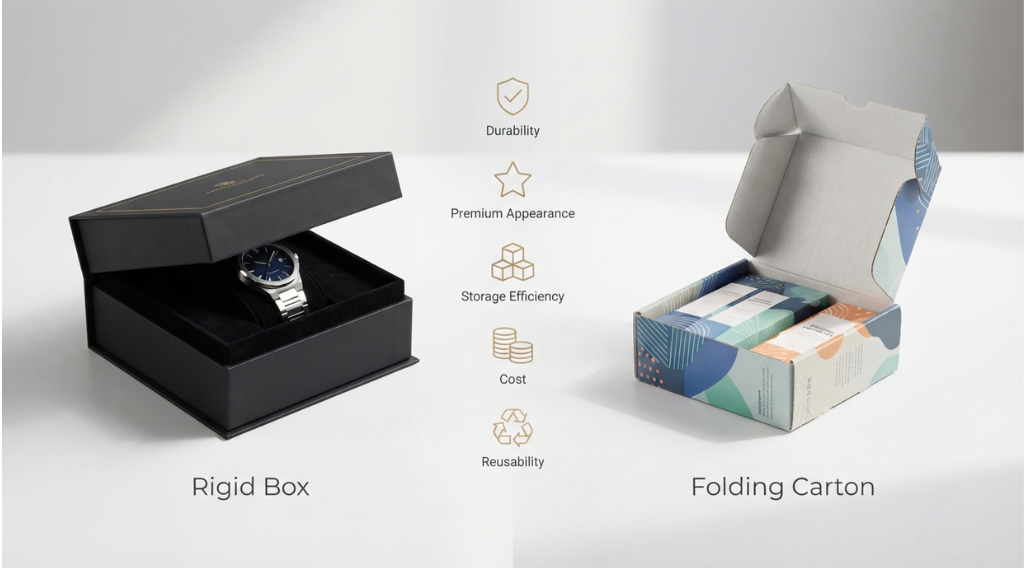
Packaging does more work than most people give it credit for. It protects what’s inside, it decides how many units fit on a pallet, and it shapes the first few seconds after someone picks the thing up. Two formats handle most of that work: rigid boxes and folding cartons. They can look almost identical in a catalog photo same printing, same glossy finish but they’re built to solve completely different problems.
Here’s a quick way to picture it. Hold a rigid jewelry box in one hand and a cereal box in the other. Both have decent print work on them. But the jewelry box doesn’t budge no matter how you twist it, while the cereal box only exists because someone folded a flat sheet into shape a few seconds before filling it. That’s really the whole story in miniature, and it’s why a rigid box on a cereal aisle would look ridiculous, and a folding carton holding a watch would feel cheap.
This piece walks through what each format actually is, where each one earns its place, and the practical questions worth asking before you pick one. For anyone after a box that’s meant to be kept, not just used, the custom rigid boxes range at Rigid Packaging Boxes (RPB) is built around exactly that.
What makes a box “rigid”
A rigid box is thick paperboard — greyboard or chipboard, usually — assembled once and never folded flat again. There’s no flat-pack stage, nobody in a warehouse creasing it into shape at 2 a.m. before a shipment goes out. It leaves the factory already a box.
Manufacturers wrap that core board in printed or textured paper, and from there it’s a matter of what the project calls for: magnetic lids, ribbon pulls, foam-lined compartments, drawer mechanisms. Most people don’t realize how much of the “premium” feeling actually comes from the material itself rather than the print on top of it. A heavier board simply reads as more expensive before anyone even notices the design.
That’s part of why watches, jewelry, high-end electronics, cosmetics, and corporate gift sets lean on this format so heavily. A customer who buys a $400 watch expects the box to survive longer than a season, and plenty of these boxes do end up repurposed — holding cufflinks, spare change, old letters — long after the original product’s gone.
What makes a carton “folding”
Folding cartons run the opposite direction. Thinner paperboard gets printed, die-cut, creased, and folded, but assembly happens right before the product goes in, not months earlier at the factory. Before that point, they sit completely flat, stacked and shipped in bundles, and get locked shut with tabs or a thin bead of glue.
That’s exactly why a cereal aisle, a pharmacy shelf, or a supplement store runs almost entirely on folding cartons. Nobody buying toothpaste expects a ceremonial unboxing. What they need is a legible ingredient list, a barcode that scans correctly, and a box that survived the truck ride without crushing. Efficiency is the entire point here, not spectacle.
The flat-pack stage is the quiet advantage most people miss. A warehouse that could store a few hundred rigid boxes can hold tens of thousands of flattened cartons in the same footprint, which is a large part of why high-volume brands never seriously consider anything else.
The one decision that explains everything else
Almost every difference between these two formats traces back to a single choice made at the manufacturing stage: does the board get assembled into its final shape immediately, or does it stay flat until the last possible moment?
That decision cascades into strength first. Rigid boxes resist crushing and bending in a way thin board simply can’t, which matters enormously for glass, watches, phones, and anything genuinely breakable. Folding cartons still protect reasonably well, especially when there’s a sealed pouch or plastic tray doing the real work inside — but past a certain point, brands just add an outer shipping box rather than switch formats entirely.
It shows up in how a box feels, too. There’s a reason a magnetic snap-close or a ribbon pull makes opening something feel deliberate rather than routine — the weight of the box has already done half the persuading before the lid even comes off. A folding carton with great print can still look sharp on a shelf, but it doesn’t carry that same physical presence in hand, which is exactly why luxury retail and corporate gifting keep defaulting to rigid construction.
And it shows up after the sale, too. Rigid boxes get repurposed. Folding cartons get recycled the moment the product’s gone, which is completely fine — they were never designed for a second act in the first place.
A side-by-side view
| Rigid Boxes | Folding Cartons | |
| Built from | Thick board, wrapped in decorative paper | Thin paperboard, folded to shape |
| Durability | High | Moderate |
| Best suited to | Delicate, premium goods | Everyday, lightweight goods |
| Before assembly | Ships pre-formed, needs storage space | Ships and stores flat |
| First impression | Substantial, weighty | Depends on the print quality |
| Custom inserts | Foam, paperboard, custom cuts | Fairly limited |
| Typical lifespan | Often kept and reused | One-time use |
| Common in | Jewelry, electronics, luxury retail, gifting | Food, pharma, household goods |
Neither one is the “better” format in any absolute sense. They’re built to win at different jobs.
Materials, briefly
Rigid box cores are almost always greyboard or chipboard, wrapped in art paper, kraft, linen, or something more textured depending on the finish a brand’s going for.
Folding cartons draw from a different family of stock — SBS board, coated unbleached kraft, folding box board, white-lined chipboard, or recycled paperboard. All of it is lighter and cheaper to print at scale, which is really the point.
How printing and finishing differ
Rigid boxes give printers a stable, forgiving surface, which is why they support just about every finishing technique available: full-color offset, Pantone matching, foil stamping, embossing, debossing, spot UV, soft-touch lamination. Anyone planning heavy custom artwork across the whole surface is usually better off going with printed rigid boxes from the start rather than retrofitting a design onto standard stock later.
Folding cartons print well too, but the job they’re doing is different. Nutrition panels, dosage instructions, ingredient lists, barcodes, regulatory disclaimers — the print has to communicate more than it decorates. Thinner board also can’t hold embossing or debossing the way a rigid box can, so whatever decorative work happens has to happen through ink alone.
Customization goes further with rigid
What rigid boxes really offer that folding cartons don’t is structural flexibility: custom sizing, drawer-style openings, book-style hinges, window cutouts, multi-compartment layouts, fabric or foam inserts. A lot of brands go the simpler route too rigid boxes with a logo printed cleanly on standard stock, no structural changes needed, just a clear, well-placed mark that does the branding work on its own.
If the real conversation is about structure rather than surface decoration, it’s worth raising that early with whoever’s actually producing the boxes — retrofitting structural changes later in a production run gets expensive fast.
Storage space is the real trade-off
Rigid boxes arrive already in their final shape, which means real warehouse space gets used up before a single unit ships. That’s a genuine planning headache for anyone ordering at scale, but it’s also exactly what keeps the product intact once it’s packed — you’re paying for protection with square footage.
Folding cartons dodge that problem entirely by shipping and storing flat. A business can warehouse thousands of them in the space a few hundred rigid boxes would need, which is a big part of why anything produced at real volume defaults to this format without much debate.
Which one actually lasts longer, environmentally
Both formats are paper-based, so neither one wins outright on materials alone — the real footprint comes down to design choices and what happens after the sale. Rigid boxes often get a second life as jewelry storage, keepsake boxes, or document holders, which stretches their usefulness well past the original purchase. Folding cartons are built for one use and typically get recycled right after, which isn’t wasteful so much as exactly what they were designed to do. Judging either format by weight or thickness alone misses the bigger picture — the full lifecycle is what actually matters.
Where you’ll actually find each one
Rigid packaging clusters wherever presentation and protection carry equal weight. Luxury fashion brands lean on luxury rigid boxes for the structural backbone behind their finishing work. Jewelry and watch brands often reach for small rigid boxes paired with drawer-style or magnetic inserts that keep delicate pieces from shifting in transit. Electronics companies go bigger, using large rigid boxes with foam-cut compartments to organize several accessories in one package. Cosmetics and fragrance houses treat the unboxing itself as part of the brand story, and corporate gifting programs use rigid construction to make several unrelated items feel like one cohesive package. Brands ordering at real volume typically move to rigid boxes wholesale once the numbers justify it, since per-unit cost drops without sacrificing that premium feel.
Folding cartons dominate everywhere volume beats ceremony. Food and beverage brands, pharmaceutical companies that need room for dosage warnings, household staples like light bulbs and cleaning products, personal care items like toothpaste or bar soap — none of these categories need a dramatic reveal. They need speed, low cost, and clear information on the box.
Making the actual call
Pick rigid construction when the box has a job beyond just holding the product real protection, a premium first impression, something worth reusing, custom-fit inserts, or an unboxing moment a customer will actually remember and maybe post about.
Pick a folding carton when efficiency matters more than ceremony the product’s light, it needs to ship and store flat, warehouse space is genuinely tight, production volume is high, or the box’s job is mostly to communicate information rather than create a moment.
The bottom line
No format wins in every situation. It comes down to matching the packaging to the product, the brand’s position in the market, and what a customer honestly expects the moment they open the thing. Everyday retail goods do perfectly well in a folding carton — nobody’s disappointed opening a box of crackers. But anywhere presentation and durability genuinely shape how a product gets perceived, rigid construction tends to earn its higher cost back.
Before committing to either, weigh the product’s weight and fragility, actual storage constraints, branding goals, and what a customer’s realistically going to do with the box once they’ve used what’s inside. Those practical details matter far more than which format looks nicer in a rendering.
Common questions
Are rigid boxes really stronger than folding cartons?
Yes — the thick greyboard or chipboard core simply holds up better under pressure than the thinner stock folding cartons use.
Which format looks more premium on a shelf or in someone’s hands?
Rigid boxes, most of the time. It’s less about the printing and more about the weight — a heavier box just reads as more expensive before anyone examines the details.
Do folding cartons make more sense for high-volume retail?
Almost always. They store and ship flat, assemble quickly at the point of packing, and leave plenty of surface area for the product information regulations often require.
Can both formats be customized?
Yes, though rigid boxes go further — magnetic closures, drawer mechanisms, specialty inserts — options that simply aren’t practical with thinner folding stock.
What’s the better choice for something fragile?
Rigid, especially when it’s paired with a foam or paperboard insert cut specifically to hold the item in place.
Do rigid boxes support premium finishing techniques?
Definitely. Foil stamping, embossing, debossing, spot UV, and soft-touch lamination all perform well on thicker board.
Are folding cartons always the cheaper option?
Not necessarily — cost depends on material, size, print complexity, and order volume. The format itself isn’t what decides price.
Which format suits a luxury brand best?
Rigid boxes, generally. The combination of solid construction and premium finishing lines up naturally with how luxury brands want to be perceived.