


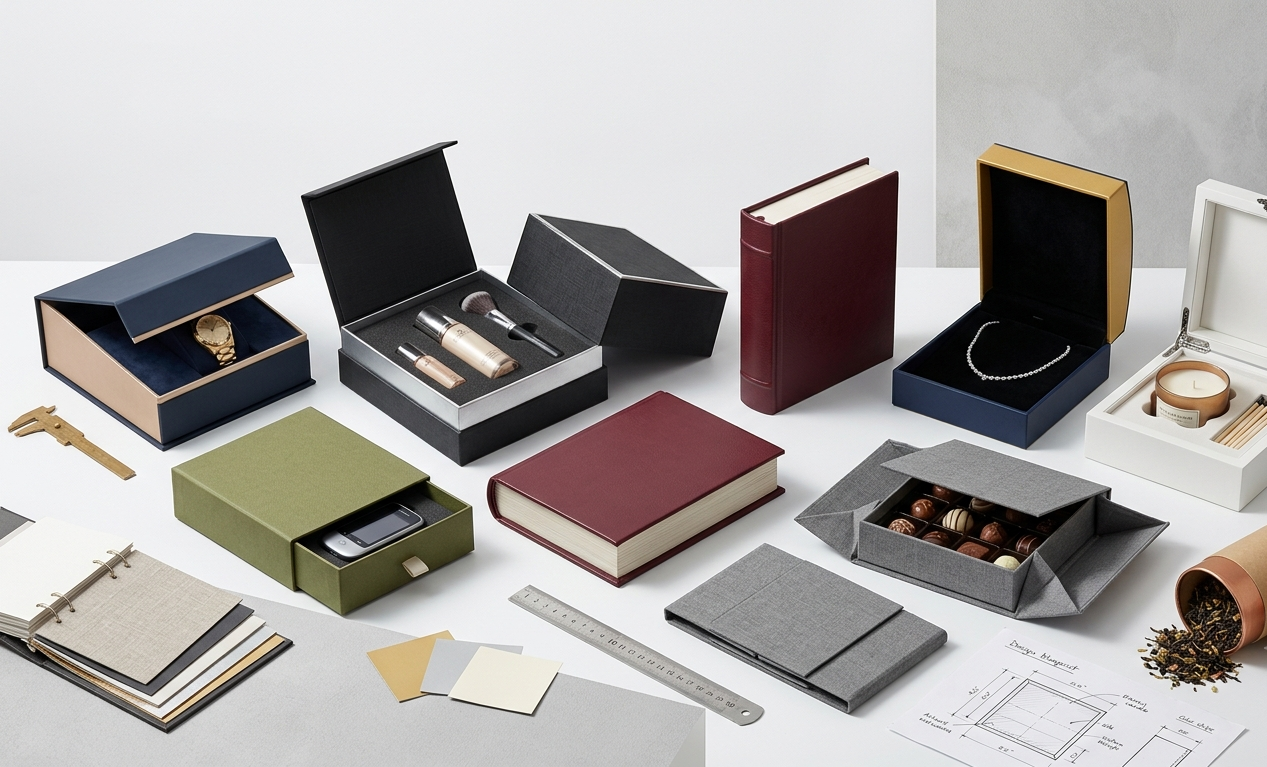
Picking packaging isn’t just finding a box that fits. The structure itself changes how well a product survives shipping, how a customer experiences opening it, and what impression a brand leaves before anyone’s touched what’s inside. Jewelry needs something different from electronics. Electronics need something different again from a corporate gift set. Getting the style right early saves a lot of redesigning down the line.
Rigid boxes come in a handful of structural styles. Each one’s built for a different job. Some are about convenience. Some exist purely for a luxury reveal. Others are there mainly to organize several items inside one package without things shifting around. Once the differences actually make sense, it’s a lot easier to pick something that matches the product instead of forcing the product to fit whatever’s already on a shelf.
This runs through the common styles, where each tends to work best, and what’s actually worth thinking about before deciding. Want the full range of what’s customizable? Our rigid packaging collection covers that in more depth.
Why structure matters more than people assume
A lot of businesses jump straight to colors and printing. But structure is what decides how the box actually performs day to day. Get it right and protection improves, the unboxing feels smoother, and the package signals quality before the lid’s even open.
Drop a luxury watch into a plain folding carton and it reads completely differently than that same watch sitting in a rigid box with a custom insert. A subscription box holding five items needs something different than a single lipstick does. The right style lets packaging support the product. Not just contain it.
What’s actually worth thinking through first
Size, for one. Compact items suit drawer-style or two-piece well. Larger products or full gift collections usually need magnetic closure or a collapsible design built to handle more volume. Get the size right and movement drops, presentation stays clean, insert design gets a lot simpler.
Weight matters too. Electronics, glassware, home décor, premium gift sets, all need a structure built to hold that weight without warping under it. Lighter items like cosmetics or stationery leave more room to choose based on look alone.
How someone actually experiences opening the thing matters as well. Slow reveal, or straight to the point? Will they keep the box afterward? Does the product need to be visible the second it’s open? Practical, or more of an event? These answers usually point toward magnetic closure, book-style, or a straightforward two-piece design.
Protection needs shift a lot by product too. Delicate materials, electronics, glass, or a handful of small accessories often call for foam inserts or divider systems, and the box style needs to actually accommodate whatever insert the product requires.
And finally, where it’s sold changes the calculation. Retail leans on shelf presentation and visibility. eCommerce leans harder on secure construction, since nobody’s handling it carefully along the way once it’s in a delivery van. Knowing which one matters more narrows things down fast.
The main styles, and where each actually fits
Magnetic closure uses a hinged lid with concealed magnets. Opens smoothly, stays shut without extra fasteners. Shows up a lot in luxury apparel, watches, electronics, corporate gifts, premium skincare. Mostly because the closure feels refined without needing anything bolted onto it.
Two-piece is probably the most recognizable rigid style. Separate base and lid, fit together. Simple by design, which is exactly why it works across so many categories, gift packaging, candles, gourmet food, cosmetics. Lid comes off completely, gives easy access, and that classic look has held up in both luxury and everyday retail for a long time now.
Drawer-style, sometimes called slide-out, has an outer sleeve with an inner tray that slides open on a ribbon pull or thumb notch. That gradual reveal makes unboxing feel more interactive, part of why jewelry, small electronics, gift cards, and beauty products lean on it so often. The compartment-friendly layout suits products with several small pieces too.
Book-style opens like a hardcover. Combines durability with a more ceremonial kind of reveal. Bigger interior gives more room for inserts and printed messaging, which is why luxury gifts, collector’s editions, and product launch kits often use it. Cover stays attached to the base, so it opens and closes easily, useful for anything that might get stored in its own box after purchase.
Shoulder neck adds a raised inner shoulder between the base and a removable lid, so a bit of it stays visible even closed. That layered look sets it apart from a plain two-piece box, and gives the lid something more secure to align against. Perfume and premium cosmetics use this a lot when a brand wants a subtle structural detail instead of leaning purely on decoration.
Hinged lid keeps the lid permanently attached, so nothing gets misplaced and there’s no separate piece to manage. Works well for anything accessed often, presentation kits, gourmet food collections, where convenience matters as much as looks.
Collapsible folds flat before assembly. Same sturdy look once built, way less storage space needed beforehand. Businesses juggling warehouse space or shipping logistics tend to lean on this for apparel and subscription boxes.
Round and tube step away from rectangular entirely. Works well for candles, bottles, tea packaging, gourmet food, anywhere a distinctive shape helps something stand out on a shelf.
Window boxes include a transparent panel so people can see part of the product without opening anything. Matters a lot when appearance drives the buying decision. Chocolates, bakery items, cosmetics especially.
Quick reference
| Style | Works well for | Main strength |
| Magnetic closure | Luxury goods, corporate gifts | Smooth, secure, reusable |
| Two-piece | Gifts, general retail | Simple and versatile |
| Drawer-style | Jewelry, electronics, cosmetics | Interactive reveal |
| Book-style | Collector’s editions, launch kits | Elegant hinged opening |
| Shoulder neck | Perfumes, luxury accessories | Layered, structural look |
| Hinged lid | Frequently accessed items | Attached lid, nothing to lose |
| Collapsible | Apparel, subscriptions | Saves storage space |
| Round & tube | Candles, bottles, food | Distinct cylindrical shape |
| Window | Anything sold on looks | Visible without opening |
Mistakes worth avoiding
Picking the look before the function. An eye-catching box doesn’t mean much if it doesn’t actually protect what’s inside or fit how it ships. Dimensions, weight, fragility, shipping method, all of it should get considered before locking in a style.
Ignoring how it actually opens. People remember the opening almost as much as the product. Drawer builds anticipation. Magnetic closure feels effortless. Book-style feels like an event. Two-piece feels classic. Matching that to the product matters more than most businesses realize going in.
Treating the interior like an afterthought. The outside only tells half the story. Without the right insert, foam, dividers, molded pulp, whatever fits, products shift in transit or look messy the second the lid’s off. Especially true for gift sets and anything with multiple small pieces.
Getting the size wrong. A box noticeably bigger than the product looks careless and lets things move inside. Building around the actual dimensions, instead of grabbing the nearest stock size, almost always gives a better result.
How customization changes things
Same base structure, completely different look depending on what gets added. Printing, full-color, Pantone-matched, interior graphics, is where most branding actually shows up. Finishing, foil stamping, embossing, debossing, Spot UV, soft-touch, adds texture on top of nearly any style without touching the underlying structure. Inserts, foam, paperboard, corrugated, velvet-covered, should get designed around the specific product. Not picked as an afterthought once the box is already decided.
Questions worth asking before deciding
What are the product’s exact dimensions? Is it fragile or heavy? Selling through retail, online, or both. Should the box be kept and reused? Does it need to hold more than one item? Will it need a custom insert? What kind of opening experience actually fits the brand? How much branding needs to fit on the surface? Working through these early saves a lot of second-guessing later.
Where this lands
Choosing the right style comes down to understanding the product first. Not chasing whatever’s trending in packaging design. Size, weight, presentation, customer expectations, all of it shapes which structure actually performs best. Instead of asking which style is “the best” in the abstract, it’s more useful to ask which one supports this specific product and brand. Get that match right, and packaging does more than hold the product. It protects it, presents it, and shapes the very first impression someone gets.
Still comparing options? RPB’s full rigid packaging range covers a lot more ground, and specific style breakdowns for magnetic closure, drawer, book-style, two-piece, and collapsible boxes go deeper if a structure’s already in mind.
Common Questions
Which style’s the most versatile?
Two-piece, generally, since it works across such a wide range of retail, gifting, and specialty products.
Best for luxury products?
Magnetic closure, book-style, and shoulder neck all tend to combine durability with a more elegant presentation.
Good for retail packaging, drawer boxes?
Yes, common for jewelry, cosmetics, and electronics specifically because the sliding reveal makes unboxing more engaging.
Best for gift packaging?
Depends on the product, but two-piece, magnetic closure, and book-style all balance presentation and practicality well.
Can every style be customized?
Most can. Dimensions, printing, inserts, finishes, branding, all flex depending on the structure.
Best for packaging multiple products?
Larger magnetic closure boxes, book-style, and collapsible designs tend to offer the most interior room for collections.
Do all styles support custom inserts?
Yes, inserts can typically be built for nearly any rigid structure.
Magnetic closure or two-piece, which one?
Premium, reusable closure matters more, go magnetic. Classic look with a fully removable lid fits better, two-piece is usually the more practical call.